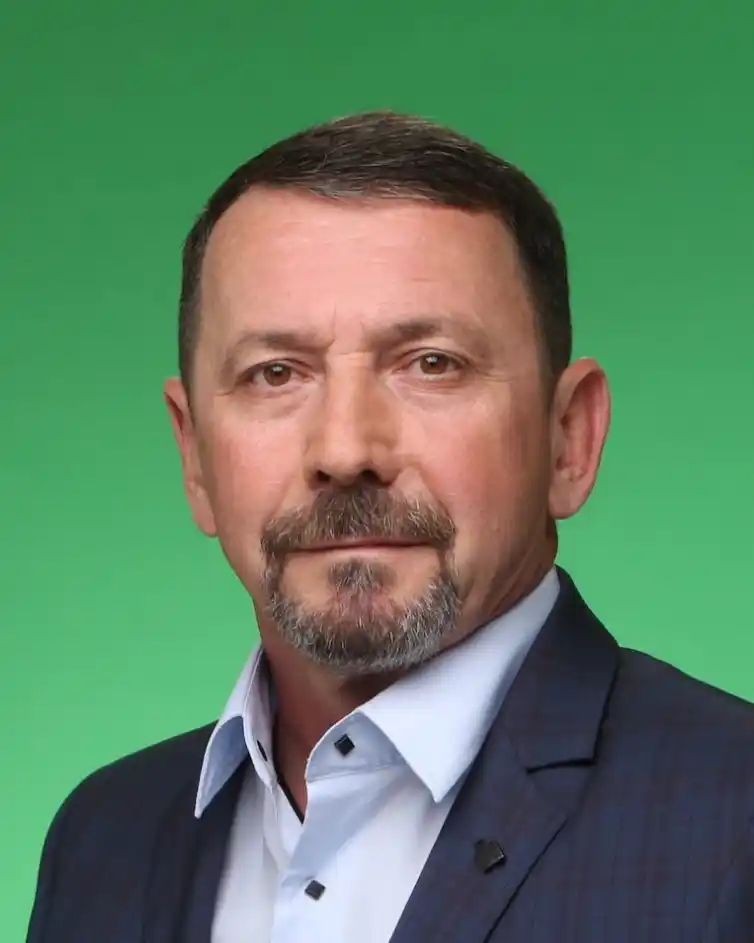
Position: People's Deputy of the Verkhovna Rada of the 9th convocation, Deputy Chairman of the "Servant of the People" faction, Chairman of the Transport Committee of the Verkhovna Rada.
Sphere of corrupt activity: legislative branch.
Region of corruption activity: Kyiv city.
Qualification: actions are qualified under Part 3 of Article 28, Part 4 of Article 368 of the Criminal Code of Ukraine.
Status: at large.
The plot of the case: in late December 2025, the SAPO and NABU exposed an organized criminal group that included members of the Ukrainian parliament. The officials are suspected of systematically receiving bribes for the "necessary" voting results in the session hall.
Back on December 27, anti-corruption authorities reported that an undercover operation had exposed an organized criminal group that included current MPs. At that time, NABU announced that the UDO was obstructing investigative actions in the Rada committees and restricting access from European Square. The UDO denied this, explaining the situation by checking people at the entrance.
According to the investigation, the group has been operating since 2021. The organizers coordinated the actions of the participants, indicating which bills or resolutions should be voted "for" and which ones should be rejected.
The amount of the improper benefit depended on the “performance indicator” (attendance in the hall and the number of projects supported). The amount of payments ranged from $2,000 to $20,000.
According to SAPO, in November-December 2025 alone, one of the group members received over $145,000 for further distribution among colleagues. The money was usually transferred on the first Thursday of each new month based on the results of work in the previous month.
On December 29, five people's deputies were charged with suspicion. Their actions were classified under Part 4 of Article 368 of the Criminal Code of Ukraine (acceptance of an offer or receipt of an illegal benefit by an official in an especially large amount).
Already on January 1, 2026, the Supreme Court of Ukraine chose preventive measures in the form of bail for five people's deputies suspected of systematically receiving bribes for voting in the Verkhovna Rada. Two of them were fined UAH 40 and 30 million, two more - UAH 20 million, and the fifth - UAH 16.6 million.
These are people's deputies from the "Servant of the People" party: Yevhen Pyvovarov, Ihor Negulevsky, Olga Savchenko, Yuriy Kisel, and Mykhailo Laba.
The court imposed a preventive measure on Yuri Kisel and Igor Negulevsky in the form of bail of 40 and 30 million hryvnias.
The court set bail for Yevhen Pyvovarov and Mykhailo Laba in the amount of 20 million hryvnias.
The court set bail for Olga Savchenko in the amount of 16.6 million hryvnias.
Also, all suspected people's deputies must hand over their passports for safekeeping and are required to wear electronic bracelets.
Later, Yuriy Kisel deposited 8 million hryvnias into the deposit account of the High Anti-Corruption Court. This happened in connection with his suspicion in a bribery case, in which the court chose a preventive measure in the form of bail for him.
Also, multimillion-dollar bails were posted for two suspects in the case of receiving bribes for voting in parliament. These are MPs from the Servant of the People party, Olga Savchenko and Yevhen Pivovarov.
According to journalists' sources in law enforcement agencies, bail in the amount of UAH 16.6 million for Olga Savchenko was paid by one of her lawyers, Igor Fomin.
In a comment to "Schemes", he reported that part of the funds contributed was his personal, and another part "had to be borrowed" due to the large amounts of collateral for the participants in the case.
On the same day, 7 individuals paid bail for MP Yevhen Pivovarov. The amounts of the payments ranged from UAH 150,000 to UAH 5 million, and the total amount is almost UAH 20 million.
More than 50 million hryvnias in bail was paid for two MPs, Igor Negulevsky and Mykhailo Laba, who are suspected of receiving bribes for voting in the Verkhovna Rada. This money was partly paid by the MPs themselves, as well as lawyers, a number of individuals and private businesses, including a company that previously paid bail for the former head of the Odessa CCC, Yevhen Borisov.
According to the journalists' interlocutors, 25.8 million hryvnias out of the 30 million bail assigned to Igor Negulevsky was paid by the Evagrain company.
Negulevsky contributed 2.9 million hryvnias. Another 1.5 million was contributed by lawyer Oleg Kuzyayev, who claims that he is not the MP's defense attorney in the "paid votes" case.
Of the 20 million hryvnia bail set by the court for another MP, Mykhailo Laba, he himself paid 499 thousand hryvnia. Three other people paid bail for him in separate amounts, ranging from 150 thousand to 3 million hryvnia.
The largest amount — 16.1 million hryvnias for the People's Deputy — was contributed by the company Tap City Service, which is registered in Kyiv. It also specializes in “wholesale trade in grain, unprocessed tobacco, seeds, and animal feed.” Since 2024, the beneficiary of this company has been Igor Protsenko, who was previously the deputy prosecutor of the Kyiv region and is now also a lawyer. According to Protsenko, he represents the interests of the People's Deputy as a lawyer, but declined to comment on the substance of the issues.
In early September 2026, the High Anti-Corruption Court extended the term of office of the People's Deputy from the faction Yuriy Kisel until October 13. NABU and SAPO suspect him of receiving illegal benefits in envelopes.
As is known, the High Anti-Corruption Court applied a preventive measure in the form of a bail of UAH 40 million to People's Deputy Yuriy Kisel. He is also obliged to: appear upon each request; not leave Ukraine without permission; report any change of his place of residence and/or work; and refrain from communicating with a number of persons regarding the circumstances of the case.
The prosecutor of the Specialized Anti-Corruption Prosecutor's Office requested that these obligations be extended for another two months.
The prosecutor's motion to extend the term of the duties assigned to the suspect (Kisiel) is granted. The term of the duties assigned to the suspect is extended for 2 months, namely until October 13, 2026.
In early October 2026, it became known that the High Anti-Corruption Court extended until December 27 the investigation period of the criminal proceedings on suspicion of people's deputies from the "Servant of the People" faction Yevhen Pyvovarov, Ihor Negulevsky, Olha Savchenko, Yuriy Kisel, and Mykhailo Laba in receiving illegal benefits.
To extend for up to twelve months, i.e. until December 27, 2026 inclusive, the term of the pre-trial investigation in criminal proceedings on suspicion (of Yevhen Pyvovarov, Ihor Negulevsky, Olha Savchenko, Yuriy Kisel and Mykhailo Laba) of committing criminal offenses provided for in Part 3 of Article 28 Part 4 of Article 368 of the Criminal Code of Ukraine
Persons potentially involved in corruption schemes: people's deputies from the "Servant of the People" party Yevhen Pyvovarov, Ihor Negulevskyi, Olha Savchenko, Mykhailo Laba.
Wealth: the property profile of the Kisel family is formed both by the assets of the deputy himself and by the significant wealth registered in the name of his wife, Valentina Kisel. Yuriy Kisel declared a residential building in Kryvyi Rih with an area of 349.9 sq. m (purchased in 2007), a land plot with an area of 1,000 sq. m (1998), and an apartment of 49.9 sq. m in joint ownership with his wife and daughter.
At the same time, the most expensive real estate objects are registered specifically for Valentina Kisel. In 2020, she purchased a house in the village of Ivankovychi, Kyiv region, with an area of 353.5 sq. m. for UAH 12,113,685, as well as a land plot of 1,200 sq. m. for UAH 1,356,504. The family also uses non-residential premises in Kyiv and Kharkiv, registered to third-party legal entities, and has two objects of unfinished construction - garages in Kryvyi Rih.
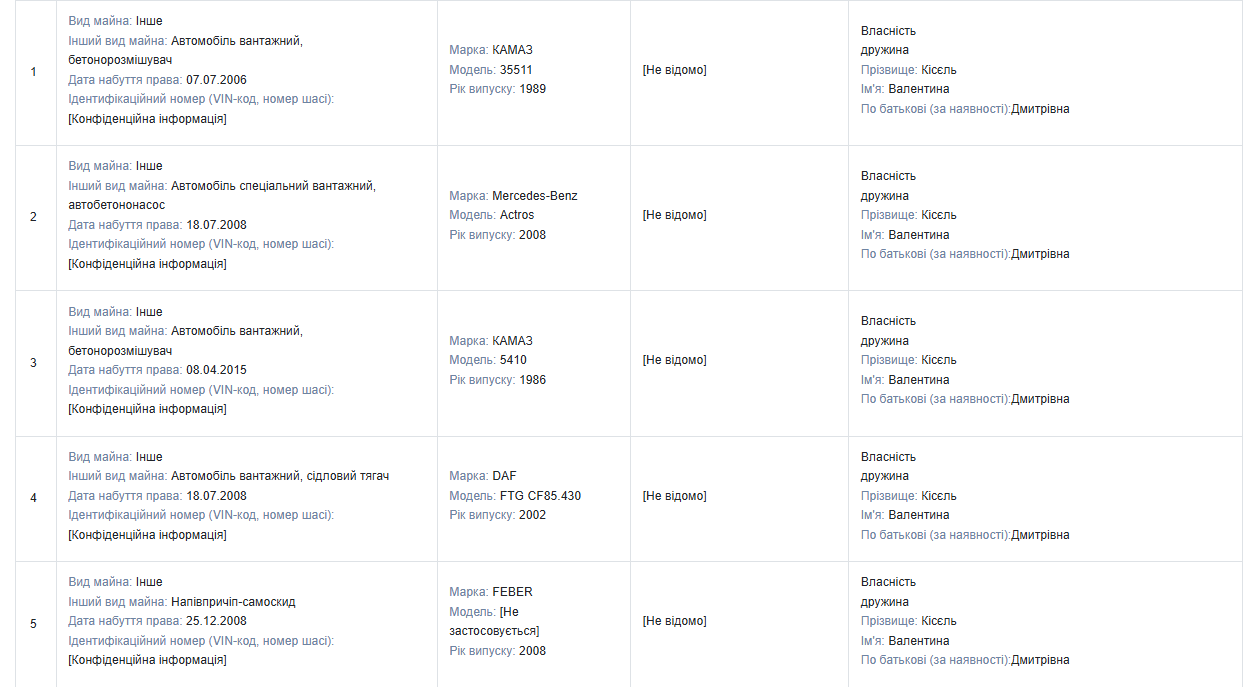
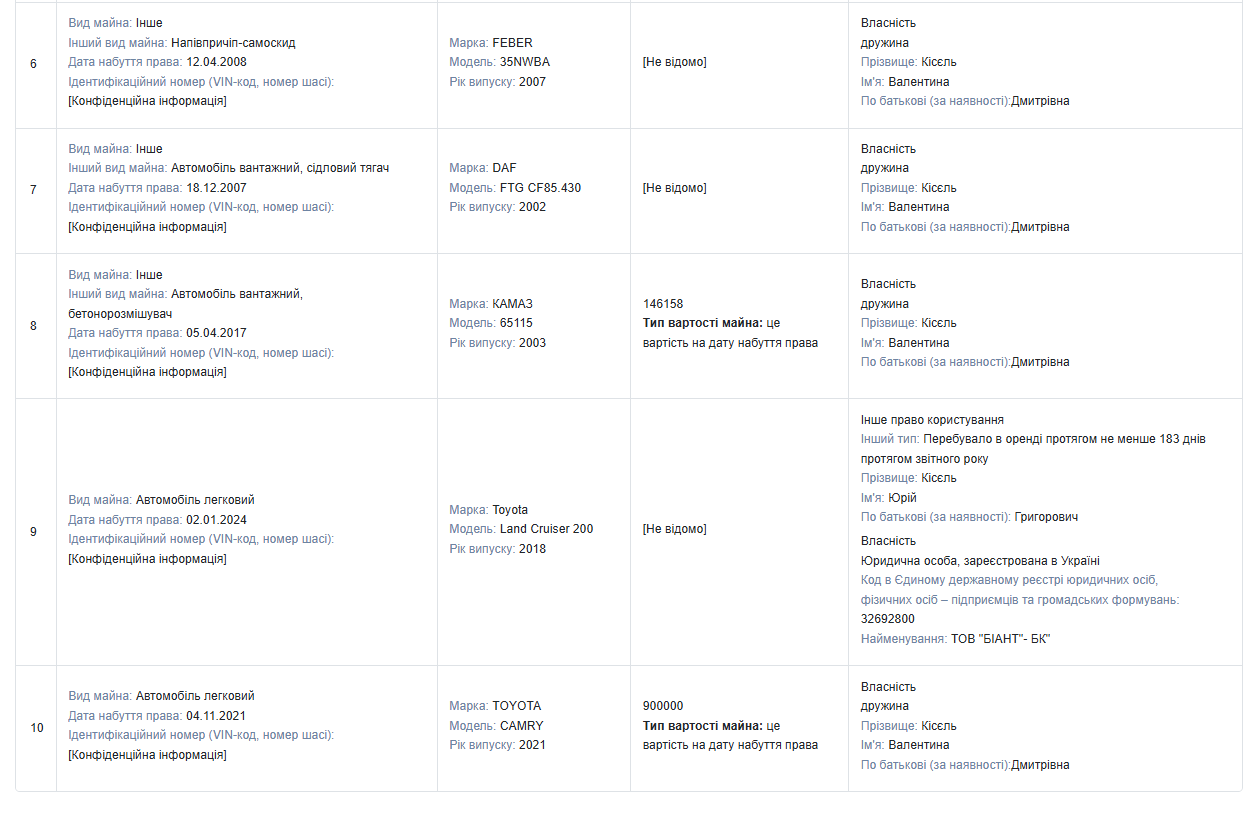
The family's fleet attracts special attention. Formally, Yuriy Kisel does not own a passenger car, but uses a Toyota Land Cruiser 200 (2018), registered to "BIANT-BK" LLC. However, a significant amount of special equipment and freight transport is declared on Valentina Kisel: KAMAZs (concrete mixers and tractors), Mercedes-Benz Actros (concrete pump), DAF tractors, dump semi-trailers, as well as a 2021 Toyota Camry, purchased for UAH 900,000 (market value - over UAH 1.2 million). This composition of the fleet directly corresponds to the construction profile of businesses associated with the deputy's family.
The family's business unit is centered around Valentina Kisel. She owns 100% of the private enterprise "Pilon", which operates in the field of construction of residential and non-residential facilities. After Yuriy Kisel was elected as a deputy, the company "Atlasinfra" was created (October 2019), related to road construction. According to media publications, this structure appeared in materials about road contracts and possible abuses in the field of infrastructure tenders; in 2020, the company ceased operations.
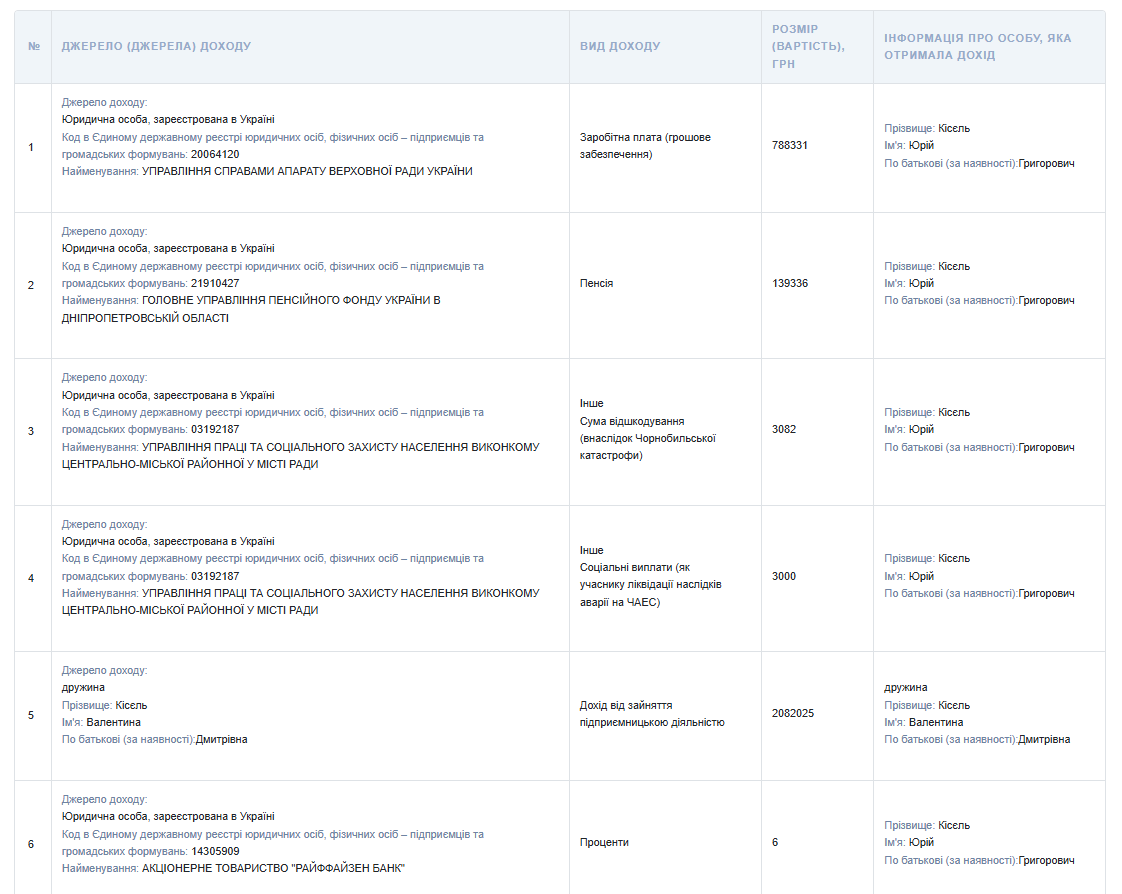
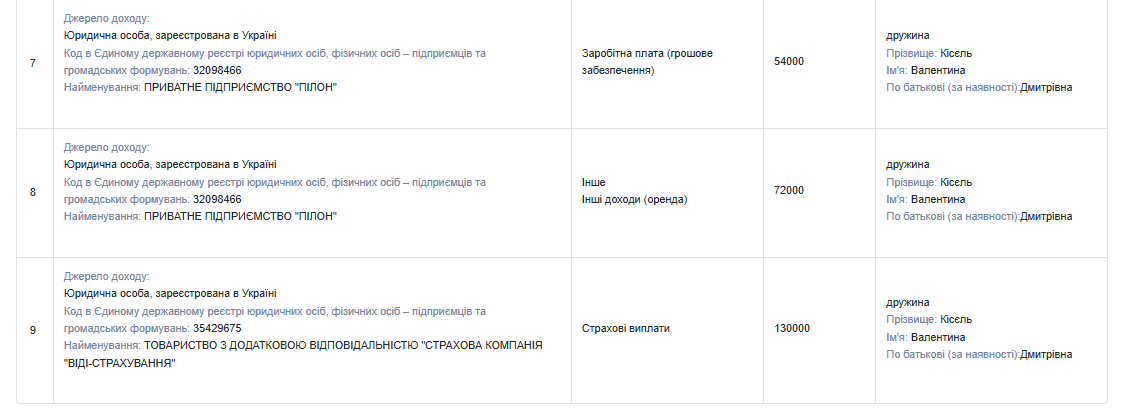
Yuriy Kisel's main income is the salary of a people's deputy (788,331 UAH per year), pension and social benefits. At the same time, Valentyna Kisel declared over 2 million UAH of income from entrepreneurial activity, as well as salary, rent and insurance payments. The family's financial assets are concentrated both in Ukraine and abroad: tens of thousands of dollars and euros in accounts, in particular in the Czech bank Česká spořitelna; significant amounts of cash were declared separately - Yuriy Kisel has tens of thousands of dollars and euros, and Valentyna Kisel has hundreds of thousands of dollars and euros.
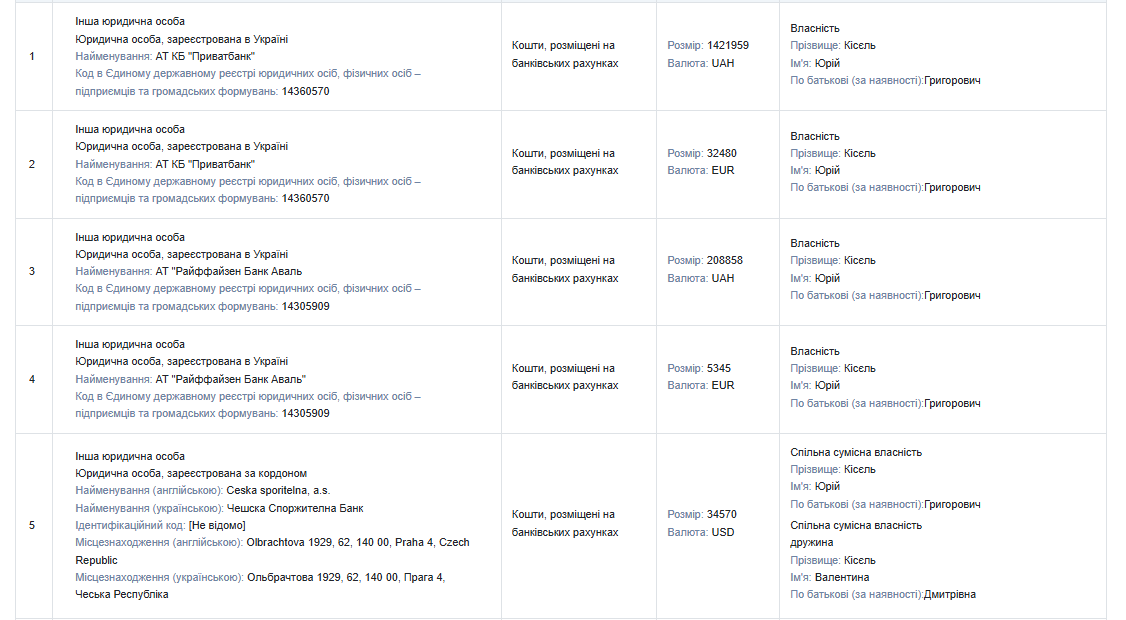
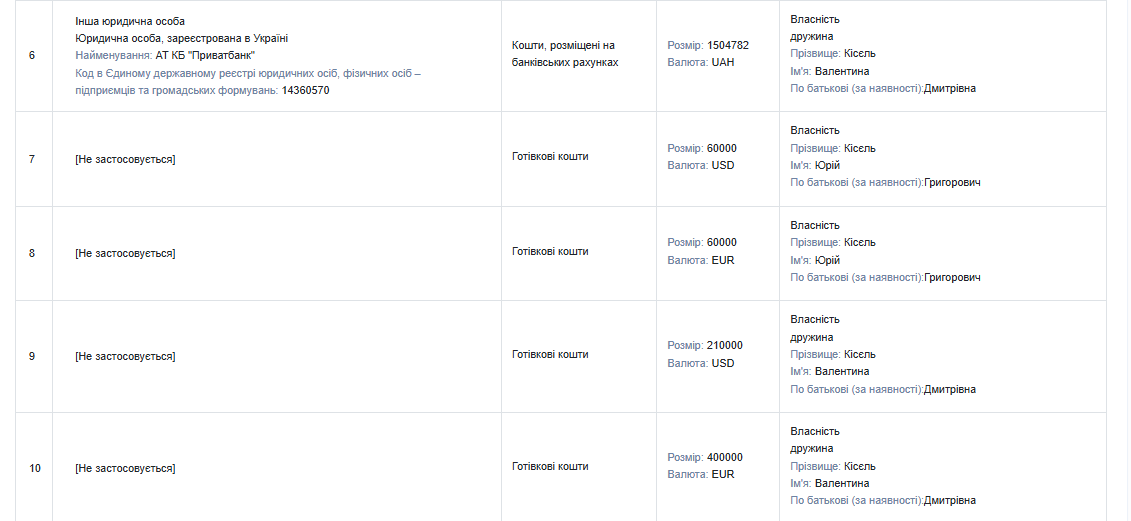
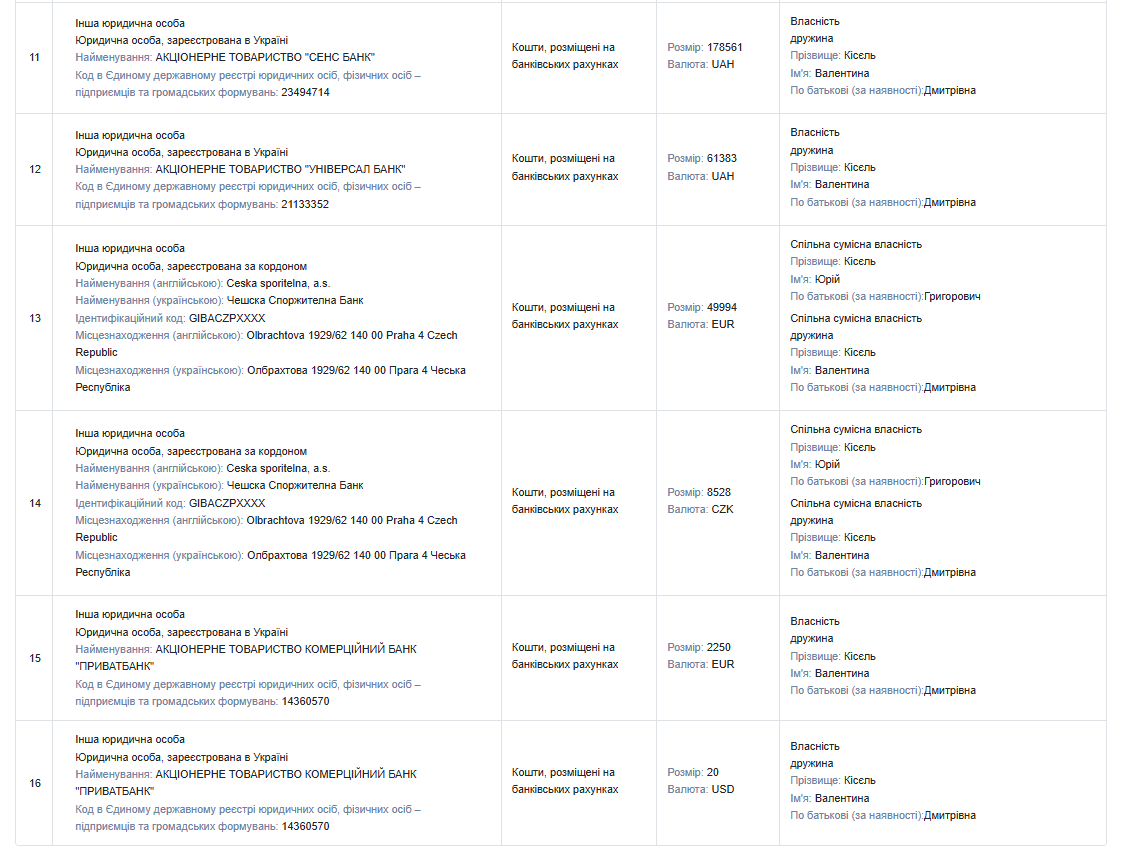
In 2024, Yuriy Kisel held UAH 1.6 million and EUR 37 thousand in banks, and had EUR 60 thousand and USD 60 thousand in cash. His wife Valentyna declared UAH 1.6 million and EUR 2.2 thousand in accounts, and EUR 400 thousand and USD 210 thousand in cash. In addition, the spouses jointly owned EUR 49.9 thousand, USD 34.5 thousand, and CZK 8.5 thousand in a foreign bank.
Persons who should have reacted: this corruption scheme should have been noticed earlier by employees, as well as heads of such law enforcement agencies as NABU, SAPO, and the Prosecutor General's Office.
Scandals: Journalists wrote about his alleged influence on the activities of the quarries of the branch of the "Industry Management Center" of JSC "Ukrzaliznytsia". According to these publications, the so-called "loss-making" quarries actually ended up under the control of structures associated with the deputy: the extracted sand, crushed stone and gravel were sold not directly, but through intermediary companies. Critics of this model pointed out that it turns a state resource into an element of private business, creates an artificial monopoly and leads to an increase in the price of construction materials within the framework of state infrastructure projects.
A separate block of claims concerned lobbying for changes in the rules of road procurement. TSN, referring to Znaj.ua. linked Yuri Kisel to Arayik Amirkhanyan, the owner of companies called "tender trolls". These structures systematically blocked road tenders, challenging the procedures, and the deputy, according to journalists, sent an appeal to the government demanding to change the terms of procurement. Critics called such actions lobbying for the interests of specific companies and an attempt to create preferences for the "necessary" market participants by crowding out competitors.
Another high-profile episode was the so-called “Kryvyi Rihgate.” Audio recordings were released in the media in which Yuriy Kisel discussed with other politicians control over the Kryvyi Rih police, commercial benefits from scrap metal operations, and even the topic of gambling. The appearance of these recordings caused a wave of public criticism, as they created the impression of using political influence for private gain.
An additional trigger for public criticism was Kisiel's vote in 2025 for bill No. 12414, which subordinated the NABU and the SAPO to the Prosecutor General. This decision caused mass protests and warnings from the public about the de facto weakening of the independence of anti-corruption bodies.
Sources:
https://suspilne.media/1201350-sap-ta-nabu-ogolosili-pidozru-patom-nardepam-za-otrimanna-habariv/
https://www.radiosvoboda.org/a/svoboda-live-nabu-skhema-deputaty-sluha-narodu/33635765.html
https://public.nazk.gov.ua/documents/0b87c2d3-1d7d-4bf4-b95b-2681fd9ea092